
Selling on Amazon has always been competitive, with millions of products fighting for the spotlight. But the rules of that competition have fundamentally changed. Amazon's discovery system is no longer just a keyword-matching engine. With the rollout of COSMO — Amazon's AI-powered ranking and recommendation system — and Rufus, its conversational AI shopping assistant now used by over 300 million shoppers, your listing needs to do far more than rank for a set of search terms. It needs to communicate structured product knowledge that an AI system can interpret, evaluate, and confidently recommend.
So where does ChatGPT fit in? It remains a powerful tool for generating listing content — titles, bullet points, descriptions, and A+ Content. But the way you use it needs to evolve. The prompts that worked in the keyword-stuffing era will produce listings that underperform in the COSMO era. This guide shows you how to use ChatGPT effectively within this new reality: creating listing content that speaks to Amazon's AI systems, connects with real shoppers, and communicates your product truth clearly.
Let's get into it.
Key Takeaways
- Amazon's algorithm has shifted. COSMO evaluates listings based on structured product knowledge — intent coverage, semantic completeness, attribute clarity, and contextual relevance — not just keyword density. Your ChatGPT prompts need to reflect this shift.
- Prime the AI with context, not just keywords. Feed ChatGPT comprehensive product details, target customer profiles, use cases, and competitive positioning. The more structured context you provide, the better the output aligns with what COSMO and Rufus look for.
- Precision prompting still matters — but the target has changed. Instead of optimizing purely for search term placement, prompt ChatGPT to generate content that answers real shopper questions, communicates benefits clearly, and covers the intent pathways your product serves.
- Keywords are still important — they're just not enough. Weave high-performing keywords into your content naturally, but ensure the listing also communicates who the product is for, what problems it solves, and how it compares to alternatives. This is what Rufus evaluates when deciding whether to recommend your product.
- Human oversight is non-negotiable. ChatGPT generates content based on prompts. It cannot conduct deep niche research, validate competitive positioning, or score your listing against COSMO's AI-readiness criteria. Always review, refine, and validate AI-generated output against your product truth.
- ChatGPT is a starting point, not the finish line. For sellers who want expert-led listing engineering — including structured intent mapping, technical scoring, and competitive analysis — ZonGuru's COSMO Transformation Service delivers what prompts alone cannot.
Understanding the Power of ChatGPT — And Its Limits
ChatGPT is a genuinely useful tool for Amazon sellers. Its ability to generate fluent, persuasive text makes it invaluable for drafting listing copy quickly — titles, bullet points, product descriptions, and A+ Content modules. Since its launch in late 2022, sellers have used it to speed up content creation and test different messaging angles.
But there is a critical distinction sellers need to understand in 2026: ChatGPT generates text. It does not engineer structured product knowledge.
Under Amazon's previous A9 algorithm, a well-prompted ChatGPT output — packed with the right keywords in the right places — could perform well. The algorithm was primarily matching search terms to listing content. In that world, AI-generated copy was often good enough.
Under COSMO, the bar is higher. Amazon's AI systems now evaluate whether your listing communicates complete, structured information about what your product is, who it's for, what problems it solves, and how it fits into real purchase contexts. Rufus doesn't just scan for keywords — it interprets your listing content to decide whether to recommend your product to a shopper asking a natural-language question like "what's the best moisturizer for sensitive skin in winter?"
This doesn't mean ChatGPT is obsolete. Far from it. It means you need to prompt it differently — and know where its output needs human (or expert) validation.
Pro tip: ChatGPT is most effective when you give it structured, detailed context about your product — not just a list of keywords. Think of it as a skilled writer who needs a thorough brief, not just a keyword spreadsheet.
Getting Started: Setting ChatGPT Up for COSMO-Era Listings
Getting started with ChatGPT is easy. Visit chatgpt.com and create an account. But before you start generating listing copy, invest time in preparation — the quality of your inputs directly determines the quality of your output.
Here's how to set yourself up for success:
- Build a product knowledge brief. Go beyond features and specifications. Document your target customer profile, the problems your product solves, specific use cases, how it compares to alternatives, and the purchase contexts where it's most relevant. This structured context is exactly what COSMO evaluates — and it's what ChatGPT needs to produce content that aligns with those criteria.
- Define your goals clearly. Are you rewriting an underperforming listing? Launching a new product? Expanding into a new marketplace? Each scenario requires different prompting strategies.
- Do your keyword research first. Tools like ZonGuru Keywords on Fire provide not just relevant search terms, but search volume, competitor rankings, and revenue potential. Feed these into your ChatGPT prompts as supporting data — not as the primary driver of your content strategy.
- Craft prompts that prioritize intent, not just keywords. Instead of "write me a title with these 5 keywords," try prompts that communicate who the product is for, what it does, and what makes it different. We'll cover specific prompts throughout this guide.
- Iterate, validate, refine. Review every output against your product truth. Does the listing accurately represent your product? Does it answer the questions a shopper would ask? Does it comply with Amazon's guidelines?
Pro tip: Take advantage of ChatGPT's custom GPTs functionality — upload a detailed product brief in text format, and let the AI integrate those specifics seamlessly into your listing copy. This ensures the output is tailored to your unique product, not generic.
Crafting Titles That Convert: Clarity Over Keyword Density
Your product title is the first thing both shoppers and Amazon's AI systems evaluate. Under COSMO, a great title is one that clearly communicates what the product is, its primary benefit, and who it's for — while still incorporating relevant keywords naturally.
Before diving into title rewrites, lay the groundwork:
- Keyword research is still essential. ZonGuru Keywords on Fire helps you identify high-performing keywords with actual search volume data. Integrate these naturally — don't force them in at the expense of clarity.
- Lead with clarity, not keyword chains. Rufus interprets your title to understand what your product is. A title that reads like a keyword dump ("Premium Organic Bamboo Charcoal Natural Teeth Whitening Toothpaste Mint Flavor") tells the algorithm less than one that communicates a clear product identity and primary benefit.
- A/B test with ChatGPT. Generate multiple title variations and track which ones lead to better click-through and conversion rates. Data should drive your decisions.
Prompt: "Write 3 Amazon product title variations for [product name]. The product is a [brief description] designed for [target audience]. Its primary benefit is [main benefit], and it differentiates from competitors because [key differentiator]. Each title should be under 200 characters, lead with the brand name, clearly communicate what the product is and who it's for, and integrate these keywords naturally: [keyword 1, keyword 2, keyword 3]. Prioritize clarity and readability over keyword density."
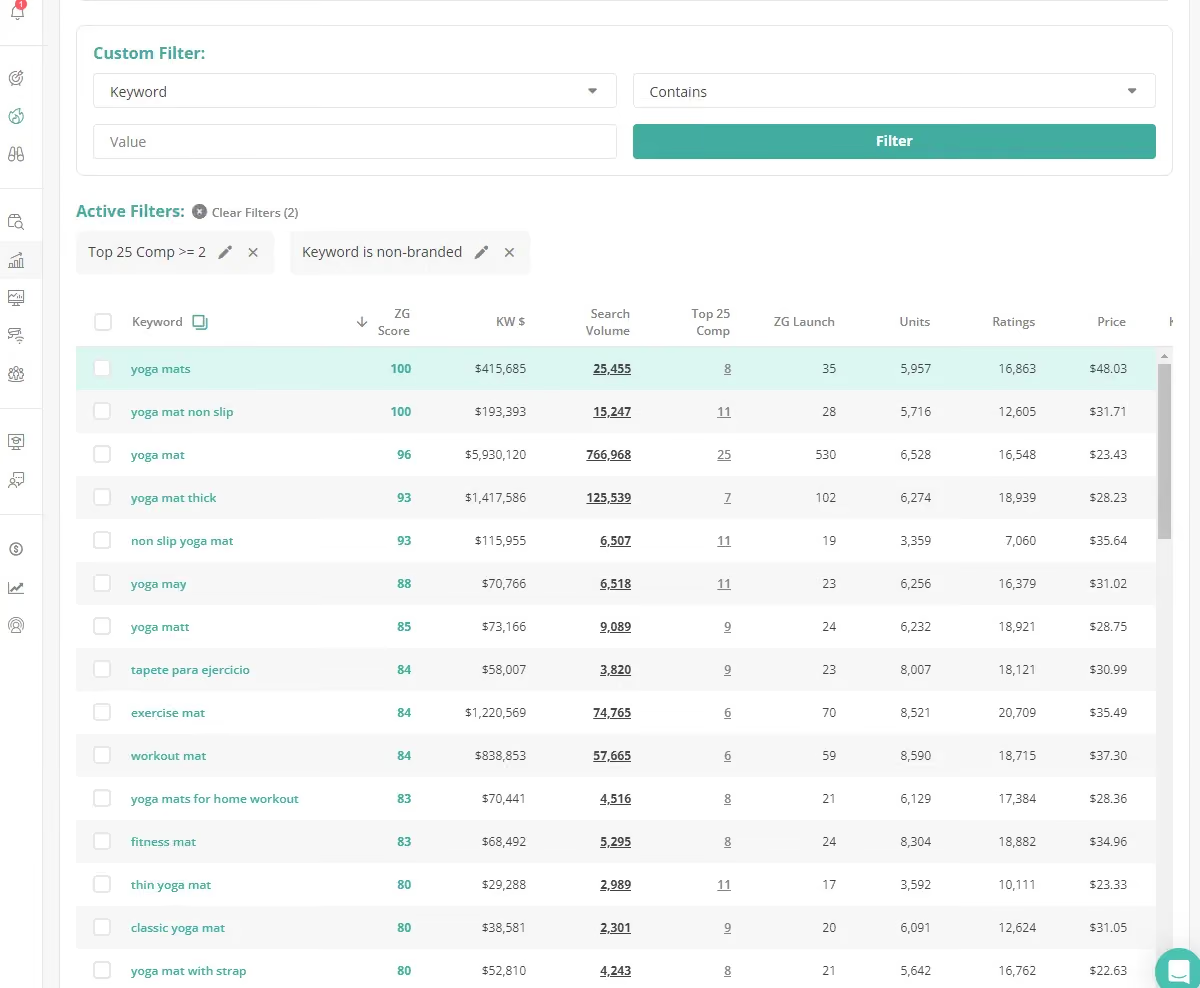
If you don't have access to a keyword tool, you can use ZonGuru's free Keywords on Fire Lite. While ChatGPT can also suggest relevant terms, it lacks search volume data — making it harder to prioritize which terms to include. Purpose-built keyword tools give you the data layer that ChatGPT cannot.
Bullet Points That Sell: Benefits, Use Cases, and Shopper Intent
Bullet points are your prime real estate for communicating the value of your product. But in the COSMO era, effective bullet points do more than list features — they connect those features to real-world use cases and purchase contexts. This is exactly the kind of structured information Rufus evaluates when deciding whether to recommend your product.
Amazon's AI shopping assistant places heavy emphasis on understanding who a product is for and what problems it solves. Listing benefits that answer the questions shoppers actually ask — "Will this work for my sensitive skin?" "Is this durable enough for outdoor use?" "Can I use this for meal prep?" — is what gets your product recommended.
Here are guidelines for COSMO-optimized bullet points:
- Lead with the customer benefit, then support with the feature. Instead of "Made with 304 stainless steel," try "Built to last through years of daily use — crafted from 304 stainless steel that resists rust, dents, and staining."
- Address specific use cases. Who is this product for? When and where do they use it? What problem does it solve? Each bullet point should answer one of these questions clearly.
- Quantify wherever possible. "Keeps drinks cold for up to 24 hours" is more useful to both shoppers and AI systems than "excellent insulation."
- Cover multiple intent pathways. COSMO maps products to shopper intents through a knowledge graph. A product with diverse, clearly communicated use cases gets discovered through more pathways than one that only speaks to a single use.
Prompt: "Create 5 Amazon bullet points for [product name]. Target audience: [target audience]. Key features: [list features]. For each bullet point, lead with a specific customer benefit or use case, then support it with the relevant feature. Address different shopper needs across the set — for example, one bullet for durability, one for ease of use, one for a specific use case, one for safety/materials, and one that differentiates from competitors. Keep each bullet concise and impactful. Integrate these keywords naturally where they fit: [keywords]. Do not sacrifice readability for keyword placement."
Writing Product Descriptions That Communicate Product Truth
Your product description is where you tell your product's complete story. While fewer shoppers read the full description, those who do are deeper in their purchase decision — and more importantly, Amazon's AI systems use this content to build a richer understanding of what your product is and who it serves.
Under COSMO, your description is not just marketing copy. It's a knowledge document. Here's how to approach it:
- Benefits over features, always. Every feature should be tied to a specific, concrete benefit. Don't just describe what the product does — explain how it improves the customer's life.
- Communicate use cases and purchase contexts. Who buys this product? What occasion, season, or scenario triggers the purchase? This contextual information is exactly what COSMO's knowledge graph uses to map your product to shopper intents you might never have explicitly targeted.
- Tell a mini-story. Narrative structure makes your listing more readable for humans and more interpretable for AI. Paint a picture of the problem your customer faces and how your product solves it.
- Maintain clarity and completeness. Avoid jargon. Be specific. Cover attributes, materials, dimensions, compatibility, and care instructions where relevant. Structured, complete information signals quality to COSMO's evaluation criteria.
Prompt: "Write an Amazon product description for [product name] (approximately 200 words). The product is designed for [target audience] who need [primary need]. Key features include: [list features]. Structure the description to: (1) open with the primary problem the product solves, (2) explain how the product addresses it, (3) highlight 2-3 specific use cases showing when and where the customer would use it, and (4) close with a confidence-building statement about quality, materials, or warranty. Keep the tone [brand tone — e.g., professional, approachable, premium]. Avoid keyword stuffing — integrate these terms naturally where they fit: [keywords]."
ZonGuru Listing Optimizer 4.0 and Keywords on Fire: Purpose-Built for the COSMO Era
ChatGPT is a general-purpose AI. It's excellent at generating text, but it wasn't built specifically for Amazon listing optimization — and it has no awareness of Amazon's search algorithm, your niche's competitive landscape, or COSMO's evaluation criteria.
That's where purpose-built tools come in.
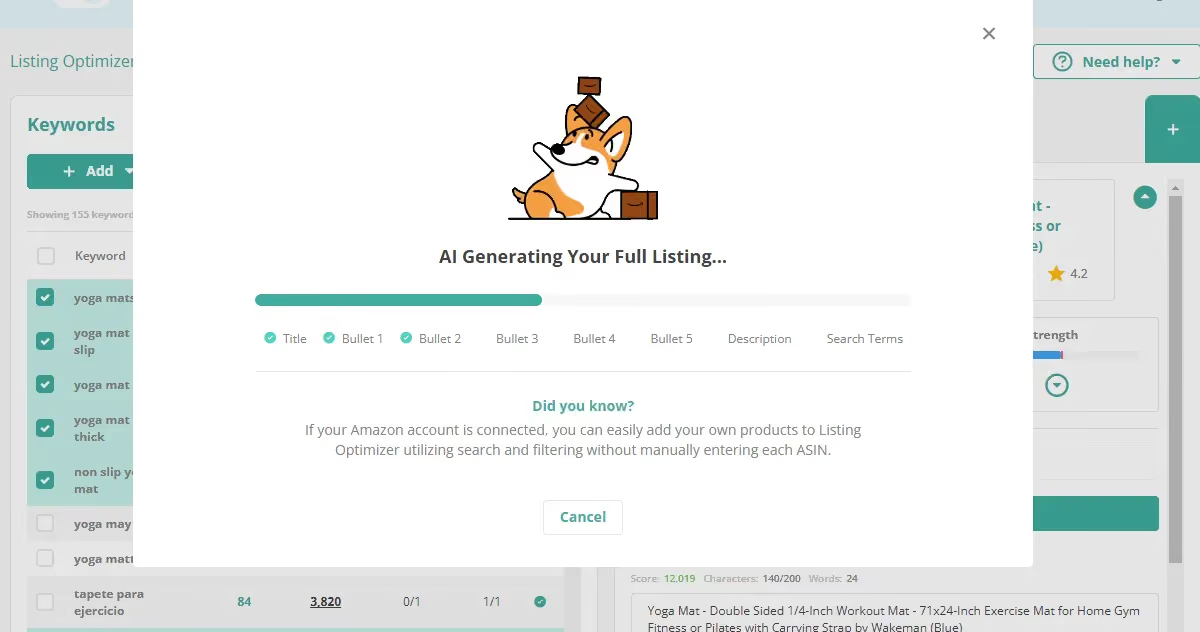
ZonGuru's Listing Optimizer 4.0 is an AI-powered listing optimization tool designed specifically for Amazon sellers. Powered by GPT-4 and built with Rufus AI optimization capabilities, it generates and refines titles, bullet points, descriptions, and backend keywords — all within a framework that understands Amazon's listing requirements and emerging AI discovery systems.
What sets it apart from using ChatGPT directly:
- Integrated keyword intelligence. Listing Optimizer connects seamlessly with Keywords on Fire, so your content is informed by actual search volume, competitor rankings, and keyword revenue data — not guesswork.
- Live scoring and competitor benchmarking. See how your listing compares against competitors in real time. Understand exactly where your listing needs improvement.
- Custom AI prompts tailored to your brand. Customize tone, format, and emphasis to match your brand voice — something that takes extensive prompt engineering to achieve with standalone ChatGPT.
- Localized language options. Optimize listings for different regional marketplaces with content that resonates with local audiences.
- Amazon-specific guardrails. The tool is purpose-built to follow Amazon's listing guidelines and best practices, reducing the risk of compliance issues that can arise from generic AI output.
- Free 7-day trial. Test it risk-free and see the difference purpose-built optimization makes.
For sellers who want to handle listing optimization themselves, Listing Optimizer 4.0 is the self-serve path — faster, more data-driven, and more Amazon-aware than prompting ChatGPT directly.
When ChatGPT Isn't Enough: Expert-Led Listing Engineering
Here's the honest truth: whether you're using ChatGPT directly or a tool like Listing Optimizer, you're still generating content from prompts. And prompts — no matter how well-crafted — have an inherent limitation: they produce text, but they don't produce the deep research, structured intent mapping, competitive analysis, and technical AI-readiness scoring that COSMO's evaluation system rewards.
This is the gap that ZonGuru's COSMO Transformation Service was built to fill.
The COSMO Transformation Service is a done-for-you listing engineering solution. It's not an AI copy generator. It applies ZonGuru's HELIX Product Knowledge Framework — a validated, expert-led methodology — to your specific product, category, and competitive landscape.
Each transformation includes:
- Deep niche research and competitive analysis
- Structured intent mapping against COSMO's discovery pathways
- Engineered listing copy (title, bullets, description, backend keywords)
- A+ Content and Brand Story content direction
- Before-and-after AI-readiness technical scoring with detailed explanations
- Image carousel analysis with specific optimization recommendations
- A ready-to-upload flat file (CSV)
- One round of guided validation and revision
The difference between prompting ChatGPT and using the COSMO Transformation Service is the difference between writing content and engineering structured product knowledge. Both have their place — but if your sessions are dropping, your organic visibility is declining, or you're launching into a competitive category, the depth of expert-led listing engineering delivers what prompts alone cannot.
Not sure where your listing stands? Start with a free COSMO Readiness Report. It scores your listing against COSMO's AI evaluation criteria across five dimensions — intent coverage, semantic structure, attribute completeness, contextual relevance, and brand authority signals — and identifies specific structural gaps. No credit card or account required. Results in under 60 seconds.
Elevating Your Brand with A+ Content: Visual Storytelling That AI Can Interpret
A+ Content (formerly Enhanced Brand Content) lets you go beyond basic text with rich visuals, comparison charts, and enhanced descriptions. In the COSMO era, A+ Content serves a dual purpose: it creates immersive product experiences for shoppers, and it provides additional structured content for Amazon's AI systems to interpret.
Visual storytelling: Use high-quality images and videos to showcase your product in action. ChatGPT can help you brainstorm concepts:
Prompt: "Suggest 5 creative visual concepts for Amazon A+ Content for [product name]. The target audience is [audience]. Focus on visuals that demonstrate specific use cases, before-and-after scenarios, and lifestyle contexts that show how the product fits into the customer's daily routine. For each concept, describe the image/scene and explain which customer benefit it communicates."
Targeted modules: Use ChatGPT to generate content for specific A+ modules — comparison charts, benefit highlights, use-case showcases, and FAQ sections.
Prompt: "Create content for an Amazon A+ Content comparison chart for [product name] vs. typical alternatives. Compare across 4-5 dimensions that matter most to [target audience], such as [dimension 1, dimension 2, etc.]. Frame the comparison to highlight [product name]'s genuine advantages without making unverifiable claims."
Pro tip: Ensure your A+ Content is optimized for mobile. A significant majority of Amazon shoppers browse on their phones. Well-structured A+ Content also gives Rufus additional context to draw from when recommending your product — so every module is an opportunity to communicate structured product knowledge.
ChatGPT for Amazon Brand Strategy: Building the Foundation
ChatGPT isn't just for product listings — it can help you define the strategic foundation that makes all your listing content more effective and consistent.
Ideal Customer Profile (ICP)
Before writing any listing copy, develop a clear picture of who you're selling to. ChatGPT can help you structure this.
Prompt: "Help me develop an Ideal Customer Profile for [product name]. The product is [description] priced at [price point] in the [category] category on Amazon. Based on these details, identify the primary customer segment, their key pain points, their purchase triggers, where they research products, and what language they use to describe their needs. Format as a structured profile I can reference when creating listing content."
Unique Selling Proposition (USP)
A clear USP ensures your listing communicates differentiation — something both human shoppers and Amazon's AI systems evaluate.
Prompt: "Craft 3 versions of a Unique Selling Proposition for [product name]. It competes against [competitor types]. Its genuine advantages are [advantages]. Each USP should be one sentence that a shopper could understand in 5 seconds. Avoid generic claims like 'premium quality' — focus on specific, verifiable differentiators."
Brand Guidelines
Consistency across your catalog signals authority and trustworthiness — factors that matter increasingly under COSMO's evaluation criteria.
Prompt: "Create a concise brand voice guide for [brand name] that I can use when creating Amazon listing content. The brand targets [audience], with core values of [values]. Define the tone (formal vs. casual), vocabulary preferences, phrases to use and avoid, and how the brand talks about quality, sustainability, and customer experience."
Final Thoughts: The Game Has Changed — Your Approach Should Too
Optimizing Amazon listings is an ongoing discipline, not a one-time task. The shift from A9's keyword-matching logic to COSMO's AI-driven interpretation means that listing optimization in 2026 requires more than clever copy. It requires structured product knowledge — content that clearly communicates what your product is, who it serves, what problems it solves, and why it's the right choice.
ChatGPT is a valuable tool in this process. It helps you draft, iterate, and test content faster than ever before. But the sellers who will win in the COSMO era are those who understand that generating text is the starting point — not the destination.
For sellers who want to move fast with a self-serve approach, ZonGuru's Listing Optimizer 4.0 combines GPT-4 with Amazon-specific keyword intelligence and Rufus AI optimization.
For sellers and agencies who want the full depth of expert-led listing engineering, the COSMO Transformation Service delivers structured intent mapping, technical scoring, and a complete transformation at $100 per ASIN.
And for anyone who simply wants to know where they stand, the free COSMO Readiness Report shows you exactly how AI-ready your listing is — in under 60 seconds.
The algorithm has moved on. Make sure your listings have too.